The public image of a life coach is a person with a whiteboard telling you to visualize success. That is not what the job is, and the gap between the cliché and the practice is most of why people who would benefit never book one.
Here is what actually happens in a session, the structure underneath it, the parts nobody advertises, and where the job stops.
The short version
A coach helps you decide what you want, get honest about where you are, generate more options than you would alone, and commit to something specific before you leave.
They do this almost entirely by asking questions. That is not a stylistic preference, it is the method: an answer you produced yourself is one you believe, and an answer handed to you is one you evaluate.
A coach who mostly tells you what to do is doing consulting. That can be valuable and it is a different service.
That is the coach's half of the hour. The other half, what you actually bring to it, is its own question with a shorter answer than most people fear.
What a session actually looks like, minute by minute
A forty-five to sixty minute session, in five movements.
Minutes 1 to 5. What happened. Not small talk. What moved since last time and what did not, in specifics. If you said you would do three sessions and did one, that is the first thing on the table, and the coach raising it without drama is the entire reason the arrangement works.
Minutes 5 to 10. What this hour is for. One topic, chosen by you, named as a sentence. Sessions that skip this wander agreeably and produce nothing.
Minutes 10 to 25. Where you actually are. The uncomfortable stretch. What have you genuinely done in three months, not intended. What did you try before and what specifically happened when it stopped. This is the part people skip when they run the session on themselves, and the part a coach will not let you skip.
Minutes 25 to 40. Options. Generated before any of them is judged. Most people produce three options, dismiss two on practical grounds, and take the one they walked in with. A coach makes you get to ten.
Minutes 40 to 50. What happens this week. One action, with a day attached. Then a question that sounds trivial and is not: how likely is that, out of ten. Under about eight, the action gets cut in half and the question gets asked again.
The last five minutes. What could stop it, what the plan is if that happens, and who else knows.
Worth knowing: the two stages that fall out when people run this alone are always the same two. Reality, because it is uncomfortable, and the commitment, because by then you feel clearer and clarity feels like completion. It is not. The full session as a solo exercise has the questions written out.
The frameworks underneath it
Three, none of them secret, and any competent coach can name the one they run.
GROW. Goal, Reality, Options, Will. Set out by Sir John Whitmore with Graham Alexander and Alan Fine in the early nineties and the closest thing this field has to a default. The four stages are the five movements above with the opening compressed.
OSCAR. Outcome, Situation, Choices, Actions, Review. The first four map closely onto GROW. The difference is the fifth, which builds review into the model rather than leaving it to chance, and over months that turns out to matter more than the front half.
Appreciative Inquiry. Starts from what is already working rather than from what is broken. Specifically useful when somebody is flat and a deficit-focused session would make things worse.
The frameworks are the easy part. What is hard is running one on yourself without quietly skipping the stage you do not enjoy.
The four things a coach does that nobody advertises
These are the job, and none of them appears in the marketing.
- Refusing to move on. A coach asks the scale question and then waits. The silence is the intervention. Almost everyone rescues themselves from silence with a better answer than the one they were going to give.
- Remembering. Not the details of your goal, which you also remember. The pattern. That this is the third time the Thursday session has moved, that you used the same sentence to excuse it in March. Nobody spots their own third time.
- Making you say the number. How likely, out of ten. It converts a vague intention into a claim you have to defend, and people revise downward the moment they have to say it aloud.
- Coming back. Next week, about the specific thing. This is the one that separates coaching from a good conversation with a smart friend, and it is structural rather than about anybody's talent.
The questions themselves
A representative dozen, so you can see what the tool actually is.
- What do you want to be true that is not true now?
- How would you know it had happened? What would you point at?
- What have you actually done about this in three months? Not intended. Done.
- What did you try before, and what specifically happened when it stopped?
- On a scale where ten is finished, where are you, and what is the evidence?
- What would you advise a friend in exactly this position?
- What is the option you have already thought of and rejected? Why?
- What would this look like at an hour a week rather than ten?
- What is the first action, and when this week does it happen?
- What is in the calendar slot that needs? What moves?
- How likely is that, out of ten?
- Who else knows this is happening?
Notice how few of them contain any information. The coach is not supplying content. They are supplying structure and refusing to let you leave a stage early.
Go further: most of these work unchanged on yourself, on paper, in about forty minutes. What does not survive the solo version is the person who comes back next week, which is the arrangement worth solving separately.
What a coach does between sessions
Frequently nothing, and that is the structural weakness of the whole arrangement.
Most coaching relationships run weekly or fortnightly because that is what people can afford. Between sessions, the standard package is a document you have and a resolution you made.
Better coaches close some of that gap. A message midweek about the commitment. A written record you both work from rather than two sets of memory. Obstacles drafted in advance so that when one arrives it is a thing you planned for rather than a surprise.
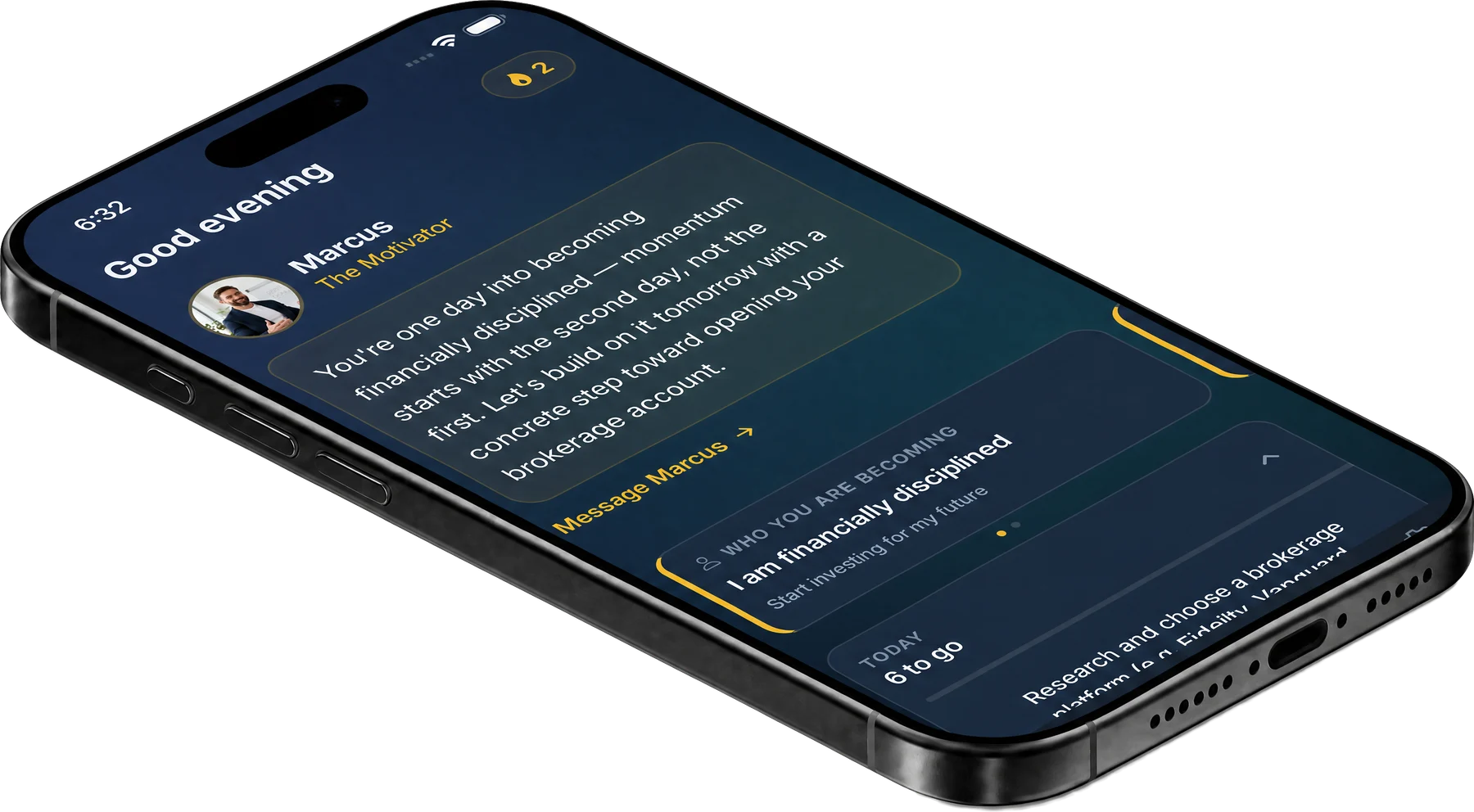
That gap is also the thing the software category was built into, and it is the honest reason to consider one: not that it coaches better, but that it is present on the Tuesday when the plan quietly stops. Where the two actually differ is a comparison of frequency more than of quality.
What a life coach does not do
Four boundaries, and the first one is not negotiable.
- It is not care. Coaching cannot address a health problem and is not a substitute for a licensed professional. A coach worth having says this early and refers out when it applies. The full boundary, and how to know which one you need, is its own page.
- It is not consulting. They are not an expert in your industry and are not there to tell you how to run it.
- It is not a credential-gated profession. In most places anyone may use the title. Accreditation exists, is voluntary, and is worth asking about precisely because it is not required.
- It is not motivation. Nobody can want it for you. The most an arrangement of this kind does is make not doing it a conscious choice rather than a drift.
How to tell a good one from a bad one
Four questions to ask before you book.
- Which framework do you run? A specific answer is a good sign. "I tailor it to the client" without naming anything is improvisation.
- What happens between sessions? The most informative question on the list, because it separates a coach with a system from one with a calendar.
- What do you not do? The answer should include care, and should be prompt.
- What does a session end with? If the answer is not something specific with a day on it, sessions will feel good and change little.
The whole thing, in five lines
- They ask rather than tell; the questions are the method
- Four stages, in order, with the uncomfortable one in the middle
- Every session ends with one action, a day, and a likelihood out of ten
- The unadvertised job is refusing to move on and remembering the pattern
- The session is not the product. The week is.
Common questions
What is the difference between a life coach and a mentor?
A mentor has done the thing you are doing and lends you their experience. A coach usually has not and is not supposed to; they are running a process on your thinking. Both are useful and they fail differently: a mentor gives you their answer, and a coach can leave you with structure and no content.
Do you need a qualification to be a life coach?
In most places, no. The title is unregulated. Accreditation bodies exist and their credentials are voluntary, which is exactly why asking about one is informative rather than rude.
How often do people see a coach?
Weekly or fortnightly is typical, monthly is common where cost is the constraint, and the frequency is usually set by the budget rather than by what the goal needs. That mismatch is the field's oldest structural problem.
What kinds of goals do people bring?
Career changes, businesses that have not started, a book, fitness, a move, a relationship with time or money. Feeling stuck is one of the most commonly reported reasons people hire one, which is a different thing from anything being wrong.
Is a life coach worth it?
It depends almost entirely on whether you leave each session with a specific dated commitment and whether anyone asks about it afterwards. Coaching that produces clarity and no commitments is a pleasant hour, and at typical rates an expensive one.
Can software do this?
The load-bearing parts, yes, and that is measured rather than guessed: on goal attainment, the outcome coaching exists for, a purpose-built coaching chatbot matched human coaches in randomised trials. The working relationship stays a human advantage. The full evidence is worth ten minutes before deciding either way.
The takeaway
A coach asks a small set of ordinary questions in a fixed order, refuses to let you leave a stage early, makes you name a number you have to defend, and comes back next week to ask about the specific thing you said.
Written out, it sounds like it should not need a professional. Most of it does not. The two parts that do are the refusing and the coming back, and those are the two parts nobody manages to do for themselves.
One thing to do today. Take the scale question and use it on the goal you have been carrying: out of ten where ten is finished, where are you, and what is the evidence for that number. The gap between the number you felt and the one you can defend is the honest starting point.