The standard advice for a stalling goal is to find an accountability partner. It is good advice with a delivery problem: most people who need one cannot easily get one, and most of the ones they do get stop working inside two months.
It is worth understanding why before reaching for a substitute, because the reason tells you exactly what the substitute has to do.
Why accountability partners fail
Almost always, it is symmetry.
The usual arrangement is two people with unrelated goals who agree to check in on each other. The failure runs like this.
One person misses a week. The other person, who also missed a week, does not want to raise it, because raising it invites the same question back. Both weeks go unmentioned. The following week there are two unmentioned weeks and the conversation is now more awkward than it was, so it does not happen either. Six weeks later the check-in is a friendly catch-up with no content, and neither of you can say when it changed.
Nobody behaved badly. The structure has no asymmetry in it. Both parties are pointed toward mutual absolution and they reliably find it.
The arrangements that survive are the asymmetric ones. A trainer does not need you to excuse their missed week. Neither does a teacher, a coach, or a class you paid for.
That is why people who cannot stick to a home workout attend a booked class for two years. The money is a small part of it. Somebody expecting them who has no reciprocal exposure is most of it.
What "being asked" has to actually do
Three properties, and a substitute needs all three.
Specific. "How's the book going" is answerable with "yeah, good", and it is going to be. "Did you do the Tuesday session" is not. The question has to name the thing you committed to, which means whoever asks has to know what you committed to.
Timed. It has to arrive close to the commitment rather than at the next social occasion. A question about Tuesday, asked on Thursday, still has something to fix. Asked in three weeks, it is archaeology.
Unavoidable. You should not be able to decline by simply not opening something. This is the property self-built systems lack, and it is why a calendar reminder does almost nothing: you dismiss it with the same thumb motion you use on everything else, and no part of the system objects.
Most substitutes get one or two. The third is the hard one and it is the one that matters.
Worth knowing: all three depend on there being a specific commitment to ask about, which is what the third question in a weekly review produces. Without that, even a willing person has nothing to ask.
Four arrangements that hold up
In rough order of effort to set up.
- Pay for a slot. A class, a lesson, a booked court, a standing appointment with anyone. This works absurdly well and people resist it because it feels like buying discipline. You are buying asymmetry, which is a real thing to buy. Any goal that can be converted into a booked appointment should be.
- Ask one person for a one-way arrangement. Not a partnership. A favor. "Every Sunday, would you text me asking whether I did the two sessions?" Small, specific, time-boxed, and people say yes far more often than you would expect. It works better if they have no interest in the goal itself, because then they have no reason to be kind about it.
- Make the miss visible to someone. A shared document, a group chat where you post a weekly line, a public log. The exposure does the work. The risk is decay into performance rather than reporting, which happens fast if the audience is people whose opinion you care about.
- Attach a consequence you cannot negotiate. Money to a charity you dislike, a forfeit with a friend holding it. Effective and brittle: it works until the first time you decide the consequence is worth taking, and after that it never works again.
How to make the ask so it gets a yes
The reason people do not ask is that they imagine a bigger request than the one they need.
What sounds like a burden: "would you be my accountability partner?" That is open-ended, undefined, and implies reciprocity nobody signed up for.
What gets a yes:
- One channel. A text, not a call.
- One day. Sunday evening, or whatever day the commitment lands after.
- One sentence for them to send, which you write. "Did the two sessions happen?"
- An end date. "For the next eight weeks" is easier to agree to than forever, and it renews easily.
- No obligation to react. They are not coaching you. They are asking a question.
Written that way it takes them nine seconds a week, and the whole thing fits in one message. It also survives the awkward case: if you missed, they have not been asked to have an opinion about it.
What does not work, honestly
Three things people reach for first, in the order they reach for them.
- Streaks and reminder apps. They record. Recording is not being asked. A streak tells you the number went to zero, and you already knew.
- Telling everyone at a party. The announcement pays out the social credit up front, which is the wrong way round. And nobody at that party is going to follow up, because following up on someone else's announced goal is socially costly and they have no reason to pay it.
- Promising yourself harder. Included because it is what everyone actually does after the other options fail. It is also why the third week is the dangerous one: the promise is the only thing scheduling the work, and the promise is what has just run out.
Where software can and cannot substitute
Software can supply the third property. It cannot supply the first engine.
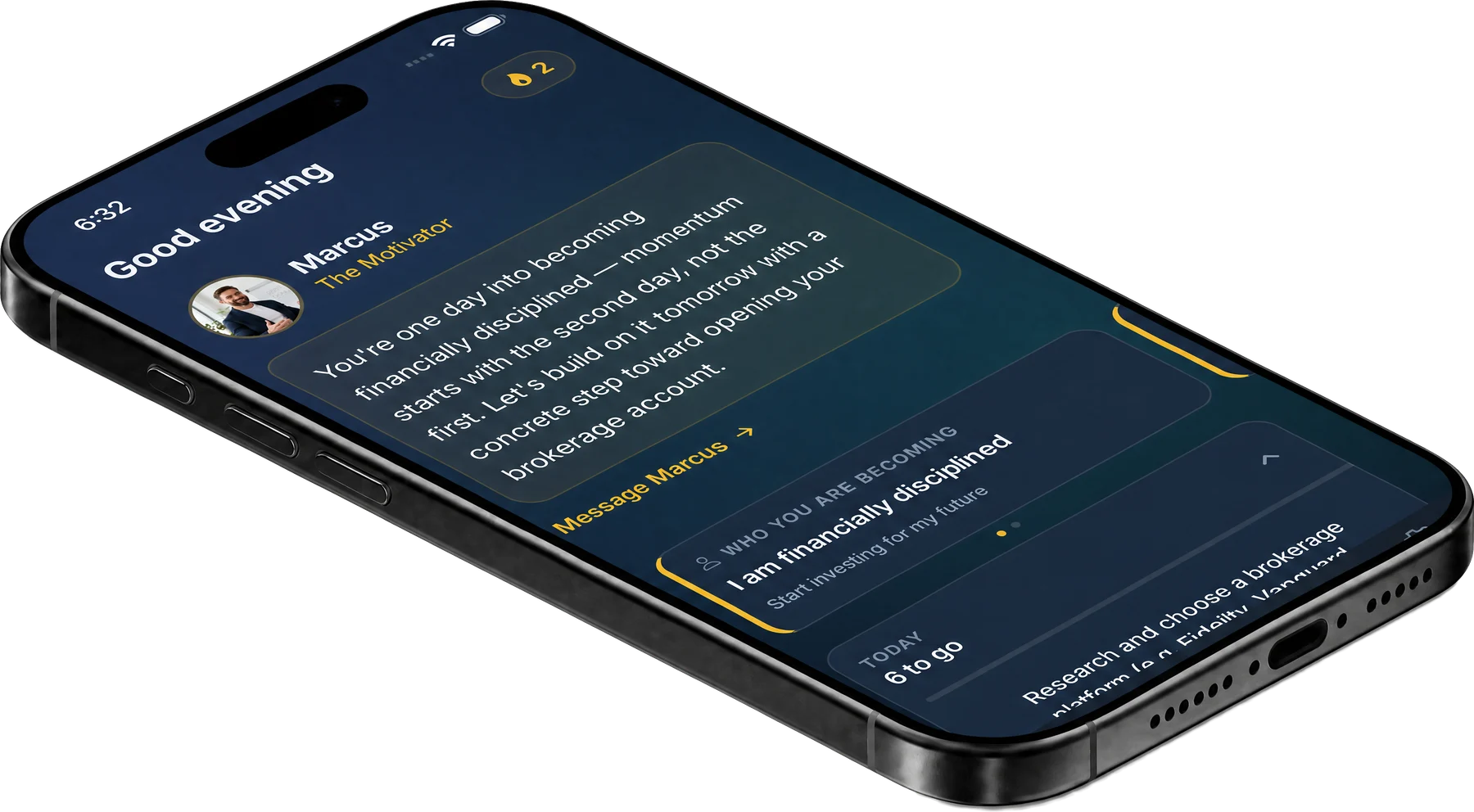
Something that arrives on a schedule you set, with your commitment named in it, is unavoidable in the sense that matters: it turns up whether or not you decide to open anything. That is a real approximation of asymmetry, and it is most of what a coaching product is for.
What it cannot supply is a person whose regard you care about. That is the engine behind a good trainer and there is no version of it in a product, which is also what the research finds when the two are compared directly. Anybody telling you otherwise is selling.
So the honest recommendation is the boring one. If you can get a person, get a person, and start with the one-way favor rather than the partnership. If you cannot, the next best thing is something that asks specifically and arrives on its own. There is a flat account of what that category does and does not do if you want to weigh it up, and a comparison against doing it in ChatGPT if that is the version you have already tried. Whether one is worth paying for turns almost entirely on the third property above, and the five kinds of accountability app, compared on it, is the version of this for someone who has already concluded no person is available.
The whole thing, in five lines
- Partnerships fail on symmetry, so do not build one
- Specific, timed and unavoidable are the three properties
- The one-way favor is the cheapest thing that has all three
- A paid slot is the strongest, wherever the goal allows one
- A streak records; it does not ask
Common questions
Is a group better than one person?
For exposure, yes. For being asked, usually no. Groups diffuse the question, so nobody is specifically responsible for noticing you went quiet, and a group where two people drift takes everyone else with it. One person with one sentence beats a group of six with good intentions.
What if I do not want anyone to know about the goal?
Then buy the slot, which is the arrangement that needs no confidant. A booked lesson or a standing appointment supplies the asymmetry without anyone knowing what the goal is or why you are there.
Will paying a coach fix this on its own?
It supplies the asymmetry, which is the hard part, and it does not supply the commitment. A coach with nothing specific to ask about ends up asking how the week went in general, which is the useless version. Bring one dated commitment per session and the arrangement does what it is meant to.
Does the person need to understand the goal?
No, and it is often better if they do not. Someone invested in the subject wants to discuss it, which is pleasant and is not the job. Someone with no stake asks the question and moves on, which is the job.
What is the minimum viable version of all this?
One person, one text, one day a week, eight weeks, and one sentence you wrote for them to send. That is the smallest arrangement that has all three properties, and it costs one slightly awkward request.
The takeaway
The thing to stop doing is the mutual check-in with a friend who has a goal of their own. It is the most commonly recommended version and it is the one with the structural flaw built into it.
Everything that works instead has the same shape: one person, or one paid slot, with no reciprocal exposure and one specific question arriving close to the commitment.
One thing to do today. Pick the person least invested in your goal, and send them this: the day, the sentence to send, and the eight-week end date. Write the sentence for them. That is the whole ask.