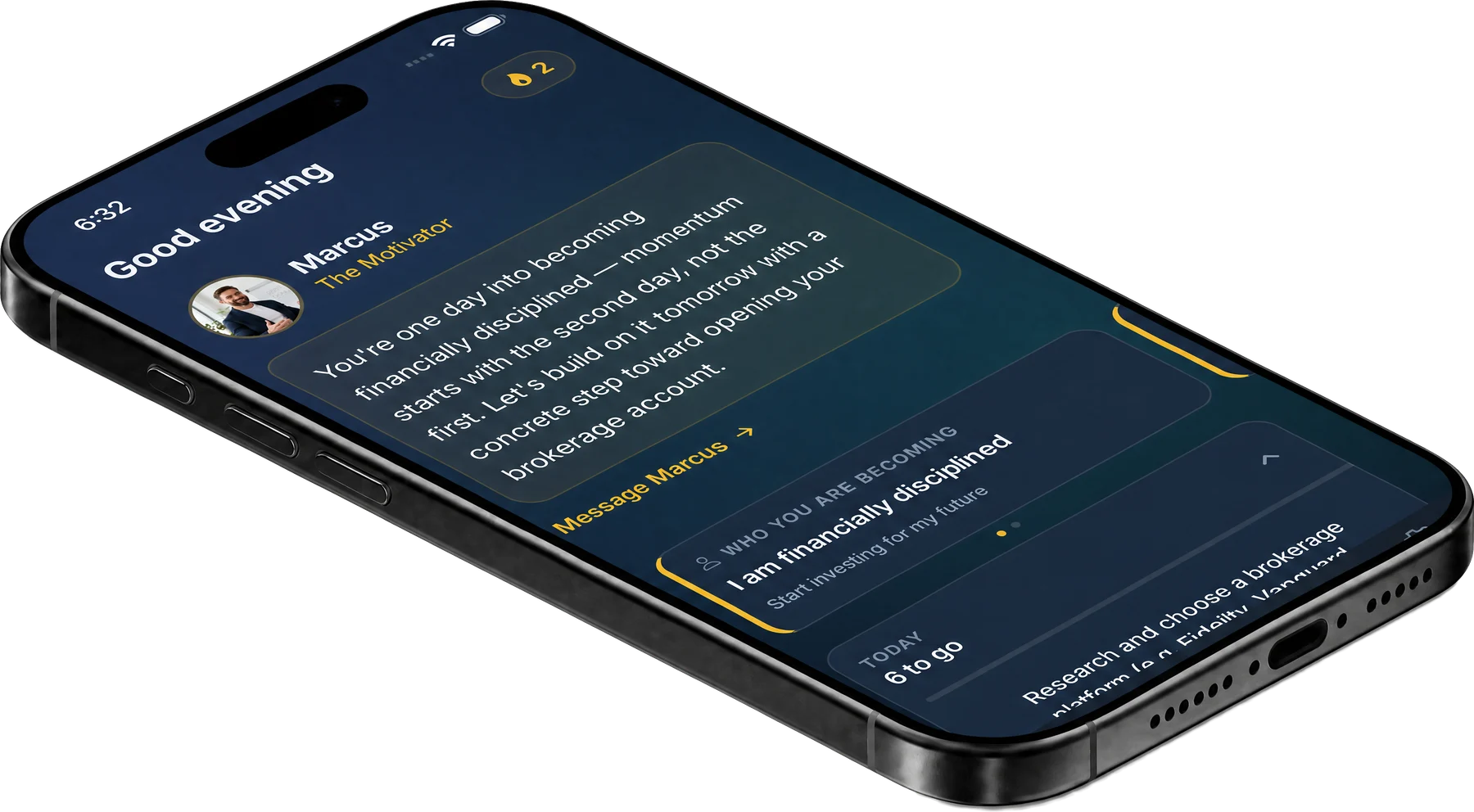
We build one of these, which you should factor in. What follows is the version we would give a friend rather than the version we would put in an ad.
The short answer is that it depends on which problem you have. The two problems people bring to coaching are different enough that the answer flips between them.
Two different problems get called the same thing
Problem one: you do not know what to do. You are considering a career change and cannot see the options. You want to start a business and have no idea what the first six steps are. You need thinking-out-loud with structure.
Problem two: you know exactly what to do and you are not doing it. The plan has been clear for two years. You could write it out in five minutes. It has not started.
For problem one, an AI coach is genuinely good, and the honest comparison is not against a human coach. It is against a good friend and a long walk. It runs the same frameworks a professional uses, it is available at eleven at night, and it does not get tired of the subject on the fourth pass.
For problem two, information is not the constraint, so anything that mostly supplies information is not going to help. What matters is whether the thing initiates. That is the question to interrogate, and it is where products in this category differ most.
What it does well
Four things, and one of them is genuinely better than the human version rather than cheaper.
- Structure on demand. The coaching frameworks are not secret. GROW, OSCAR, Appreciative Inquiry: any of them holds up a useful session. What is hard is running one on yourself without skipping the uncomfortable stage, and having something else run it fixes exactly that.
- No scheduling. A human coach is available on Tuesday at four. This is available when the thought occurs, which is usually not Tuesday at four.
- No social cost. People are meaningfully more honest with a machine about how badly something is going, especially in month five of something they announced at a dinner party in January. That is the one place the AI version is better rather than cheaper.
- Memory, if the product has it. A coach with the last three months of your goal in front of them asks a different question from one meeting you fresh. This varies enormously between products and it is the thing most worth checking.
What it does not do
Four limits, and the last one is the one that decides whether a subscription is worth keeping.
- It is not care. Coaching is not treatment and nothing in this category substitutes for a licensed professional. If what is actually in the way is a health problem, this is the wrong shelf, and any product that blurs that line should worry you.
- It cannot read the room. A human coach hears the pause before you answer. Text does not carry that, and a product claiming otherwise is overselling.
- It has no stake. A person you have paid and will see again on Thursday is a different kind of commitment. Some of what makes human coaching work is simply that somebody is expecting you, and that asymmetry has no full substitute.
- It does not chase you unless it was built to. Most of them were not. This is the big one and it is the subject of the next section.
The three questions worth asking
These are the ones that separate products, and none of them is about which model it runs on.
One: does it start the conversation, or does it wait? Most of these are chat interfaces. A chat interface is a room you have to decide to enter, and on the week you most need a coach you do not enter it. Ask whether anything arrives without you opening the app, and on what schedule.
Two: does it remember, and where does the memory live? There is a real difference between a product that keeps your goal, your milestones and what you said last month as structured records, and one that has a long conversation history it may or may not consult. The first behaves like a coach. The second behaves like a very good chat window. That is also the main structural difference from using ChatGPT directly, which is a fair comparison to make since it is free.
Three: what happens on the week you do nothing? This is the whole test. A tracker records the zero. A coach asks about it. Whether a given product asks, and whether it asks in a way that gets an answer out of you, is the difference between a subscription you keep and one you cancel in March.
Worth knowing: ask question three about a specific week. "It sends reminders" is not an answer. "On Thursday it asks about the commitment I made on Sunday, by name" is one, and most products in this category cannot say it.
How to test one in a fortnight
You do not need three months to find out, and the trial is the wrong thing to spend it on.
- Day one: give it the goal you have actually been carrying, not a fresh one. A new goal makes every product look good, because week one is free.
- Set the check-in rhythm and then ignore the app for four days. What arrives, and does it name anything specific.
- Have a deliberately bad week. Do nothing on purpose and watch what the product does with that. This is the test most people never run and it is the only one that matters.
- In week two, ask it about something from week one without pasting the context back in. That tells you whether the memory is structured or decorative.
- Read one thing it wrote you and ask whether a person would have said it. Register is not a nicety here; you are going to be reading this on bad Tuesdays.
If it passes the bad week and the memory check, the rest is preference. If it fails either, no amount of conversational quality is going to fix it.
The comparison people actually make
Most people weighing this up are not choosing between an AI coach and a human coach.
They are choosing between an AI coach and nothing, because a human coach at typical rates is a real monthly commitment, and the goal in question has been sitting there for six years without one.
On those terms the arithmetic is not close, and that is the honest argument for the category rather than any claim about matching a person. Something that runs a structured session and comes back to it beats a notebook you stopped opening.
As for whether it beats a good human coach: that is the wrong question. A good human coach is better in the session, and nothing here argues otherwise. What a person cannot do at any normal price is be there the rest of the week, which is where goals are actually won and lost. And on the result itself, a chatbot coach matched human coaches on goal attainment in randomised trials.
When to skip it
Three cases, and they are not edge cases.
- You want accountability from a person and would be disappointed by anything less. Then buy that, even if it is a class rather than a coach. The one-way favor costs nothing and works better than most software.
- The underlying issue is medical. Wrong shelf entirely.
- You are expecting the purchase itself to do something. That is the failure mode for every tool in this space, including the notebook, and it is worth naming because it is the most common one.
The decision, in five lines
- Which problem you have: not knowing, or not starting
- Whether it initiates, or waits for you to open it
- Whether the memory is structured records or a chat log
- What it does on a week you did nothing
- What you are actually comparing it against, honestly
Common questions
How much does an AI life coach cost?
Most sit somewhere between a streaming subscription and a gym membership, annually cheaper than monthly, and every one of them is a fraction of what a human coach charges. Ours is on the pricing page with both periods shown. The number that matters is the annual one, because this is not a tool you evaluate in a fortnight.
Is it better than ChatGPT with a good prompt?
For a single session, often not by much, and that is worth saying plainly. The difference shows up across months: a fresh session remembers nothing, and nothing arrives unless you start it. The full comparison is here, and the twelve questions that separate products are the longer version of this section. If free is the question, what the free route does and does not get you is the honest map.
Will it actually keep me consistent?
No product can promise that, and one that does is telling you something about how it was built. There is randomised evidence on goal attainment specifically, along with measures that did not move at all, and the honest read on it is worth ten minutes. What a well-built one changes is the number of days the goal is in front of you rather than out of mind, and week three is where you find out whether that was enough.
Is my data private?
Ask two specific questions of any product: which company's model generates the replies, and whether you can delete everything. For ours, messages go to Anthropic to produce the replies, and deleting your account removes everything in it.
Can it replace a human coach?
For structure and frequency, largely. For the part where somebody whose regard you care about is expecting you on Thursday, no, and nobody in this category has a version of that. If you can afford a human coach and get on with them, that is still the better product.
The takeaway
The category is worth it for one of the two problems and conditional on one property.
If you need to think something through, almost any of them will do it well. If you need to start something you already understand, the only question that matters is what arrives without you opening anything, and most of them fail it.
One thing to do today. If you are trialling one, give it the goal you have actually been carrying, then do nothing for four days on purpose. What shows up in that window is the product.