Most guides to this category are affiliate listicles. Ten products, a paragraph each, a table with green ticks in it, and a rank order that tracks commission rather than quality.
This also assumes you have already landed on the right category. A plain search for a life coach app turns up practice software for professional coaches and human-coach directories at least as often as it turns up anything that coaches you directly, so if any of the products below look like the wrong kind of thing entirely, that is likely why.
We build one of these, so we are not going to rank anyone. What follows is the set of questions that actually separates the products, written so you can go and ask them yourself. Several of them we would fail in places, and those are marked.
Start by naming which problem you have
The category answers two different problems, and the right choice flips between them.
- You do not know what to do. A career change with no visible options. A business idea with no first six steps. What you need is structured thinking-out-loud, and almost anything in this category, including a general chatbot with a good prompt, will do it competently.
- You know exactly what to do and you are not doing it. The plan has been clear for two years. You could write it in five minutes. It has not started.
If it is the first, buy on conversation quality and stop reading guides. If it is the second, conversation quality is nearly irrelevant and the rest of this page is the list of things that are not.
Most people carrying a goal for years are in the second group and shop as though they are in the first.
The twelve questions
Grouped by what they are actually testing. Ask them of any product, including ours.
Does it initiate?
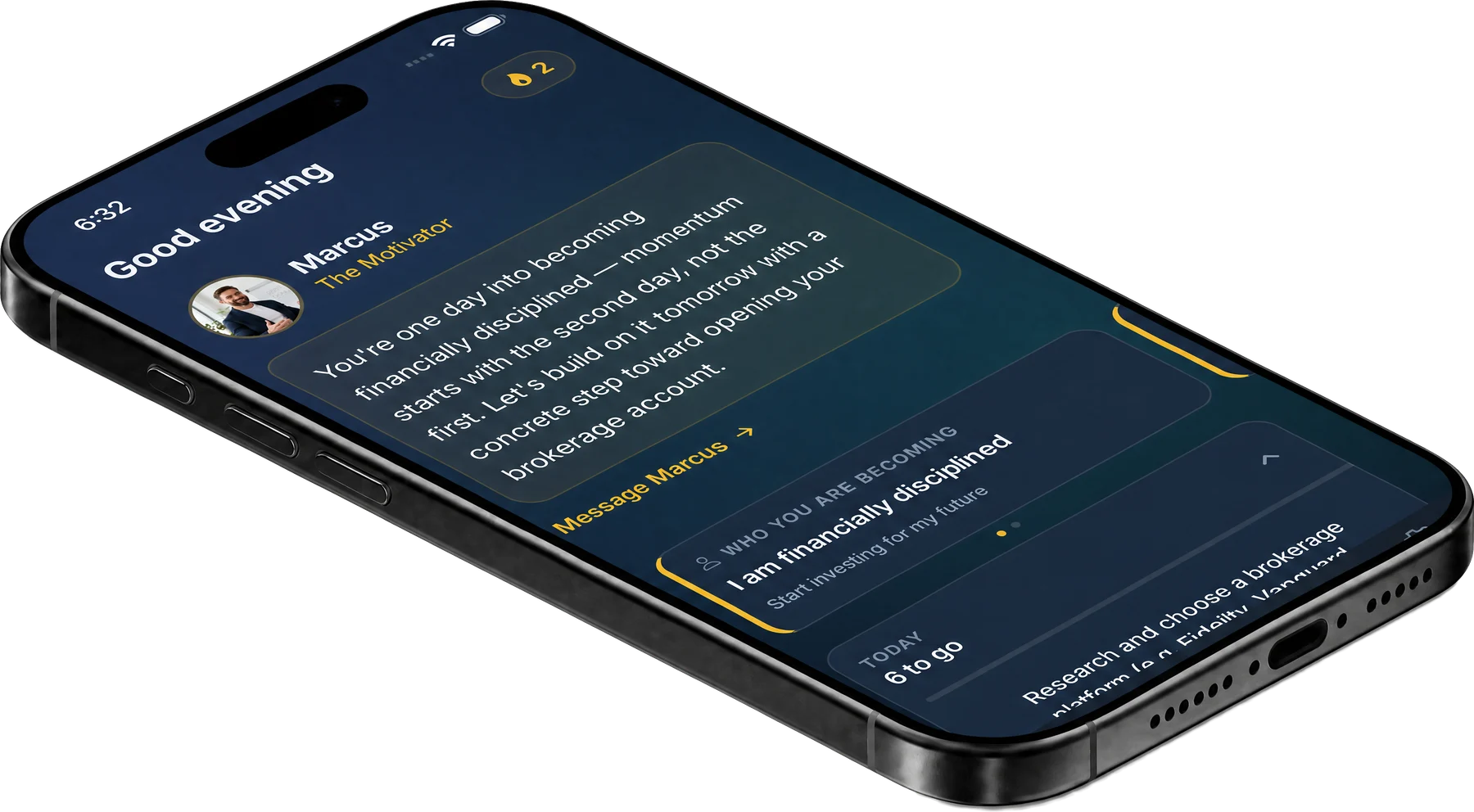
1. Does anything arrive without me opening the app, and on what schedule? This is the question. A chat interface is a room you have to decide to enter, and the week you most need a coach is the week you do not enter it.
2. Is what arrives specific, or is it a reminder? "Time for your check-in" is a reminder, dismissed with the same thumb motion you use on everything else. "Did the Tuesday session happen" names something you committed to.
3. Can I set the rhythm, or is it fixed? A cadence you chose survives a busy month. One imposed on you gets muted in week three.
What does it remember?
4. Where does my goal live? Ask for the noun. If the answer is a record, a goal object, a plan with milestones, that is structured memory. If the answer is "in your conversation history", that is a chat log with search.
5. Can it refer to something from six weeks ago without me pasting it back in? Test this rather than asking it. Week two of a trial is enough.
6. If I said something important in month one, does it come back on its own? Retrieval on demand is a search box. A coach brings things up.
What is it actually doing?
7. Which coaching frameworks does it run, by name? GROW, OSCAR and Appreciative Inquiry are the ordinary answers and none of them is proprietary. A product that cannot name one is improvising, which is fine for a chat and not what you are paying for.
8. Does it push back, or does it agree? Language models are agreeable by default. A coach that never says "that is the fourth time you have moved that step" is a pleasant conversational partner and nothing else.
9. What happens on the week I do nothing? A tracker records the zero. A coach asks about it. This is the whole test and it is the next section.
What are the terms?
10. What does it cost annually, not monthly? This is not a tool you can evaluate in a fortnight, so the annual figure is the real one. Ours is on the pricing page with both periods shown.
11. Which company's model generates the replies, and can I delete everything? Two specific questions with two specific answers. Vagueness here is the answer. For ours: messages go to Anthropic to produce the replies, and deleting your account removes everything in it.
12. What does it refuse to do? Anything in this category that will not say plainly that it is not care, cannot address a health problem, and is not a substitute for a licensed professional is telling you something about how carefully it was built.
Worth knowing: questions 1, 4 and 9 do most of the work. If you only ask three, ask those. Everything else is a tiebreak between products that pass them.
The two-week testing protocol
Free trials are designed to be flattering. Here is how to make one informative.
- Day one: bring the goal you have actually been carrying. Not a fresh one. A new goal makes every product look good because week one runs on novelty, and week one is not where goals fail.
- Day one: set the check-in rhythm, then close the app for four days. What arrives? Does it name anything specific, or is it a nudge?
- Days five to eight: have a deliberately bad week. Do nothing on purpose. Watch what the product does with a zero. This is the test almost nobody runs and it is the one that predicts month four.
- Week two: ask about something from week one without pasting the context back in. That tells you whether the memory is structured or decorative.
- Week two: disagree with it once. Say the plan is wrong. A coach explores that. A chatbot agrees with you and rewrites the plan.
- Throughout: read one message and ask whether a person would have written it. Register is not a nicety. You are going to be reading this on bad Tuesdays.
If it passes the bad week and the memory check, everything else is preference. If it fails either, no amount of conversational quality fixes it.
Go further: the reason to weight the bad week so heavily is in the research. Across the trials that exist, frequency of use predicted the size of the effect, which makes "am I still using this in month four" the only purchase criterion with evidence behind it. The full read on that evidence includes what did not work.
Four claims to walk away from
Each one tells you something specific about the company.
- Anything that edges toward care. Coaching cannot address a health problem and is not a substitute for a licensed professional. A product blurring that line has either not taken advice or has taken it and ignored it.
- A promised outcome. Pounds, income, a transformed life by a date. Nobody can promise an outcome that depends on what you do, and the closest thing to evidence in this field found no effect on general wellbeing at all.
- Live awareness. Any claim that the product perceives what you are doing as you do it, or reacts to a silence. Most of these send local notifications written in advance, so the text existed before the moment it describes. Ours works that way too, which is why we are specific about it.
- A round number with no paper behind it. "Users are 3x more likely to." Ask which study. The silence is the answer.
Where Odyssey sits against this list, stated plainly
A buyer's guide from a vendor that skips its own gaps is an advertisement, so here is both halves.
- The three questions that carry the list are the ones we built for. A coach who initiates on a rhythm you set, goals and commitments held as structured records, and a named framework stack: GROW, OSCAR, Appreciative Inquiry. That is also the design class the research tested.
- Voice is not included. It is listed as coming soon and it ships in neither plan today. If talking rather than typing is what would make you use it, wait for it.
- No software refers you to care, ours included. A human coach can notice something is outside their remit and send you to someone; where that line sits is worth knowing before buying anything in the category.
- Android is not out yet. iPhone first; the waitlist is on the support page.
If you decide against the whole category
Two alternatives that are better than a bad choice here.
Buy a slot with a person. A class, a lesson, a standing appointment. It supplies the one thing no product in this category has, which is somebody expecting you who has no reciprocal exposure. Why that asymmetry is the active ingredient is worth ten minutes.
Or run the machinery yourself. The frameworks are not secret, the GROW questions are a full session you can do with a notebook, and three questions on a Sunday is most of a review. What that route lacks is anything arriving on its own, and that is a real limitation rather than a marketing line.
Or decide the job was different all along. The top self improvement apps, sorted by job covers the rest of the shelf, meditation to habit tracking, one pick per job.
The checklist, in five lines
- Which problem: not knowing, or not starting
- Does it initiate, specifically, on a rhythm you set
- Is the memory a structured record or a chat log
- What it does on the week you did nothing
- The annual price, the model provider, and the deletion policy
Common questions
Is there a best AI life coach?
Not in any general sense, and a guide that names one without asking which problem you have is not answering the question. The category splits cleanly between thinking-things-through and getting-started, and the products that are good at one are frequently indifferent at the other.
How long should I trial one?
Two weeks, and the protocol above matters more than the duration. A month of enthusiastic use tells you less than fourteen days containing one deliberately bad week.
Should I just use ChatGPT instead?
For a single session, often yes, and it is worth knowing that before paying for anything. What a general assistant does not do is start the conversation or hold a goal across months without you rebuilding the context. The full comparison is here.
Do the free ones work?
For thinking something through, frequently. For the initiating half, almost never, because sending scheduled outbound messages costs money per user and a free tier cannot carry it. That is an economics answer rather than a quality one, and what free does and does not get you is worth knowing before you shop either way.
What if I have tried apps like this before and stopped?
Then you already have the most useful data in this whole exercise. Work out which week it stopped and what was happening then, because that is the failure the next product has to survive. The restart procedure opens with exactly that question.
Does the underlying model matter?
Less than the questions above, and not nothing. Model quality decides how good a single conversation is, which is question one of twelve. The other eleven are product decisions that no model choice fixes.
The takeaway
Twelve questions, and three of them carry it: does it initiate, where does the goal live, and what happens on the week you did nothing.
Everything else in this category is a preference between products that answer those three well. Anything that fails them is a chat window with a coaching prompt on it, which is a real thing with real uses and is not what you were shopping for.
One thing to do today. Whatever you are trialling, do nothing on it for four days on purpose and read what turns up. That single test sorts this market faster than any list, including this one.