Search the phrase and you get lists of twenty-five apps, which is how you end up with a folder called Growth on your phone and nothing changed by November.
The problem with "top self improvement apps" as a question is the word top, which quietly skips the only question that matters: top at what? An app store category called self improvement contains meditation timers, calorie trackers, flashcard engines and journals, and ranking them against each other is like ranking a kettle against a ladder.
So this list is sorted by job. Eight jobs, the standout app or two for each, checked against where each product stands in August 2026, and one honest disclosure up front: Odyssey, the coaching entry, is ours. No app here paid to be included, there are no affiliate links, and the right number to install is probably two.
Meditation and sleep: Headspace and Calm
Best for: building an actual sitting practice (Headspace) and falling asleep (Calm).
The two category leaders for a decade, and still the two to compare. Headspace is the better teacher: structured courses that take you from nothing to a real daily practice, with a friendly, plain-spoken style. Calm leans toward the evening, with its enormous library of sleep stories and wind-down sessions. Both are subscriptions, both are polished, and the honest tiebreak is which end of the day you are buying help with.
Habit tracking: Streaks and Habitica
Best for: quiet consistency (Streaks) and people who want it to be a game (Habitica).
Streaks is the polished Apple option, an Apple Design Award winner, bought once rather than subscribed to, and it does one thing with real care: a small grid of habits you tick, with health goals logged automatically. Habitica turns the same job into a role-playing game, with experience points, quests and parties of other humans, and it is the deepest free option if game mechanics are what keep you moving. Pick by temperament, and keep the habit list short either way.
Both record rather than ask, which is the line worth knowing if what you actually wanted was somebody checking. The accountability shelf is its own category, and a shared habit grid sits at the weak end of it. And a habit tracker is a narrower tool than it looks: if the thing you are actually holding is a goal with a deadline or a hierarchy of subgoals rather than a daily tick, the goal-setting shelf has its own standouts.
Journaling: Day One
Best for: a private written record you keep for years.
The standard since 2011, and still the app the rest of the category is measured against. End-to-end encrypted, synced everywhere, with the On This Day feature that resurfaces old entries and quietly becomes the reason people stay for a decade. If the job is reflection rather than record-keeping, though, an app may not be the bottleneck at all: journaling and coaching do different work, and it is worth knowing which one you are actually shopping for.
Fitness and food: Strava and MyFitnessPal
Best for: training you can see (Strava) and eating you can measure (MyFitnessPal).
Strava is where runs and rides live, and its real product is the social layer: efforts get seen, which for a lot of people is the difference between training and intending to. MyFitnessPal remains the default for food logging, with the largest database and the least friction. Both reward a specific, narrow goal, and neither will supply one.
Focus: Forest
Best for: staying off your phone for one block of work.
A timer that grows a tree while you leave the phone alone, and kills it if you do not. It sounds too cute to work and it works, because it converts an abstract intention into one concrete visible stake. Forest is the right size for its job: nobody needs a focus platform.
Language: Duolingo
Best for: showing up to a language every day.
The category is not close. Duolingo made daily practice frictionless and free, and its lesson design gets you to a real base in a way that a shelf of textbooks mostly does not. Its famous streak pressure is either fuel or noise depending on your temperament. What it cannot do is decide why you are learning, and the learners who last tend to have an answer.
Reading: Libby
Best for: actually reading more, for free.
The quietest recommendation on the list and possibly the best. Libby connects to your library card and lends real books and audiobooks at no cost, which makes it the rare self improvement app with no upsell anywhere in it. Reading more is the goal under half the goals people set, and this is the lowest friction route to it.
Coaching: Odyssey
Best for: a goal you keep not getting to, and the follow-through it needs.
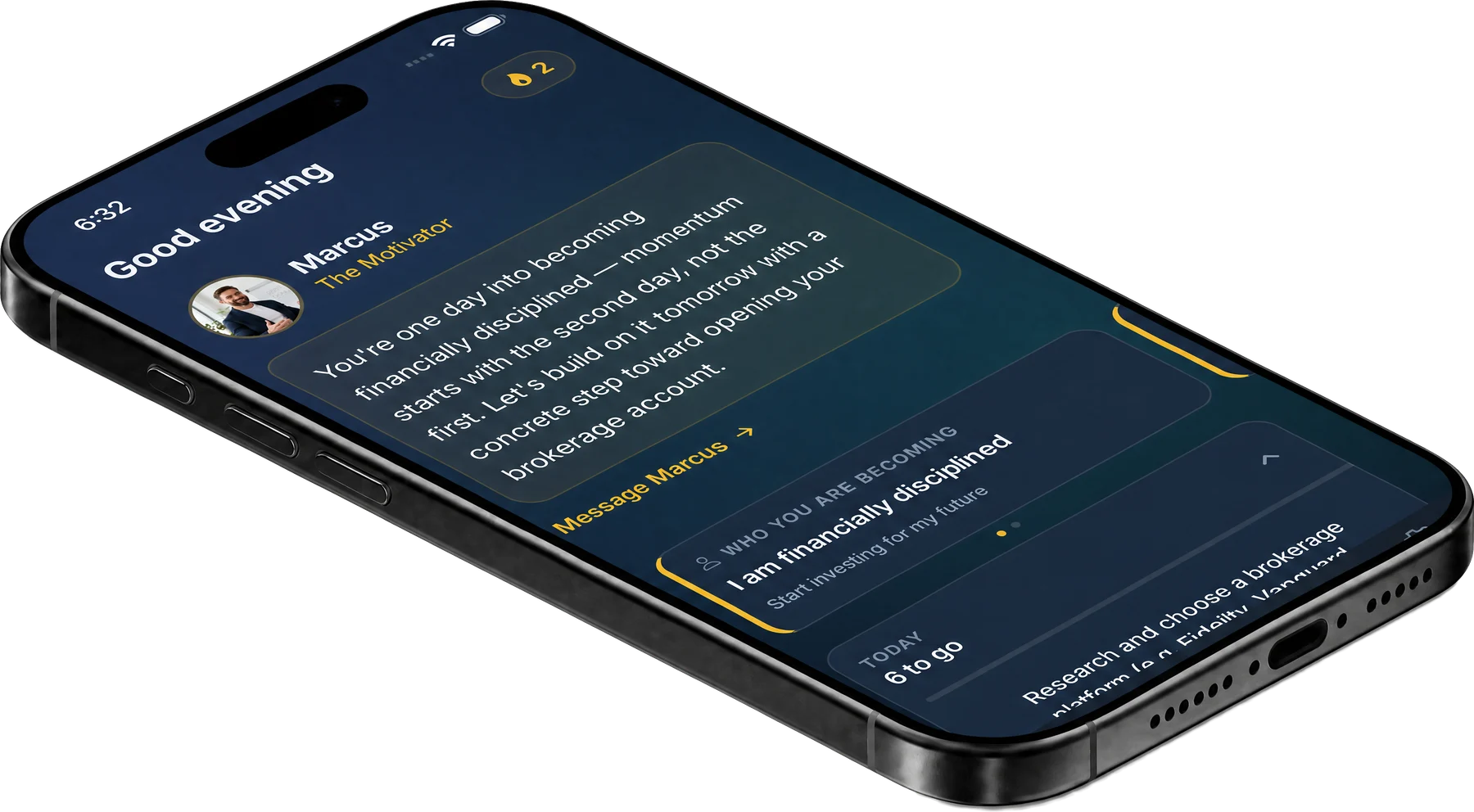
Ours, so weigh everything in this entry accordingly. Every app above is a tool that waits for you to open it, which is exactly right for a tracker and the known weakness of every self improvement folder: the apps are fine and the opening stops. Coaching is the category built the other way around. In Odyssey you pick a coach, build a plan with them, and the app then reaches out on the rhythm you set: check-ins, plan cues, a weekly review that reads your week back to you. The coaching itself runs on the methods professional coaches actually use, and what an AI life coach is, honestly is written up separately, including what the category cannot do. Pricing lives on the pricing page and the App Store, which always has the current figure.
How to choose, and how many to install
Pick the job first, then one app per job, then stop.
The folder of twelve is not a strategy, it is a collection, and collections are one of the ways ambition procrastinates. If what you typed into the search box was the singular version of this question, the self growth app guide walks the choice from the want backwards. The working method:
- Name the goal before the app. Not "get healthier", but the specific thing you would regret not starting this year. The app follows from the job, never the other way round.
- One app per job. Two habit trackers is zero habit trackers. Where two apps above share a category, they serve different temperaments, so pick and commit.
- Run a two-week test. An app that has not earned a daily or weekly place in fourteen days is not going to. Delete it without ceremony.
- Watch the new-app feeling. Installing something is a fresh start feeling, and fresh starts are the easy half. Starting was never your problem, and no install fixes middles.
The shelf in five lines
- Name the job before comparing apps. Top at everything is top at nothing
- Meditation and sleep: Headspace to learn, Calm to wind down
- Habits, journaling, focus: Streaks or Habitica, Day One, Forest
- Training, language, reading: Strava and MyFitnessPal, Duolingo, Libby
- Coaching is the one category that reaches out, and ours is Odyssey
Common questions
What is the best self improvement app overall?
There is no honest overall answer, because the category is a shelf of different tools. The best app is the one matched to the goal you would most regret ignoring this year: Headspace for a practice, Streaks for consistency, Day One for reflection, Strava for training, Duolingo for a language, Odyssey if the missing piece is follow-through. Anyone ranking a journal above a meditation timer is ranking their own preferences.
Are self improvement apps worth paying for?
Worth paying for when they do a job you keep showing up to, and not before. The free tiers and the two-week test settle it empirically: use the free version until the limitation actually bites, then pay for exactly that. Whether coaching specifically is worth it is its own question, and the honest answer depends on whether being asked is the piece you are missing.
How many self improvement apps should I have?
Two or three, each mapped to a job you are actively working. Past that, the folder itself becomes a small procrastination device: organizing tools feels like progress and costs nothing. If an app has not been opened in a month, it is not part of your life, and deleting it is the honest move.
Do self improvement apps actually work?
It depends on the category and, mostly, on whether the app gets opened, which is the quiet failure mode of the whole shelf. For AI coaching specifically there are independent randomised trials, and we wrote them up honestly, nulls included, because that category makes checkable claims. For most other categories the app is a tool, and a tool works when a goal is driving it.
What is a good free self improvement setup?
Libby for reading, Duolingo for a language, Habitica for habits, and a plain notes app for a weekly review. That covers four jobs at no cost, and the free coaching routes are written up separately, including what the free versions genuinely do well.
The takeaway
The shelf is full of good software, and the ranking question is the wrong one. Name the goal you would regret ignoring this year, install one app for that job, give it two weeks, and let the rest of the folder go.
One thing to do today. Open your phone and delete every self improvement app you have not opened this month. What survives is your actual system, and it is now visible enough to improve.