The search happens after a specific failure. You told yourself you would go three times a week, you went twice the first week and once the next, and by the third week nobody had noticed, because there was nobody to notice. So you go looking for an app that will be the person.
The store returns dozens, and they look interchangeable. They are not. Some pair you with a stranger, some charge you money when you miss, some are habit grids with a friend attached, and some are coaching products, and each of those is solving a different half of the problem you actually have.
Worth being clear before any of it: this is the second-best answer. A real person you would be embarrassed to disappoint beats every app in this category, and the arrangement to try first is a one-way favor rather than a partnership. This piece is for the case where that is not available, which is most cases.
What follows: the one property that decides whether any accountability app works, the five kinds and what each genuinely supplies, the failure mode they share, and a short way to pick.
Accountability is being asked, and everything else is bookkeeping
The property that matters is a specific question, arriving on its own, from something you cannot silently ignore.
Break down what a good gym partner actually does and it is three things: they know exactly what you said you would do, they turn up whether or not you feel like it, and letting them down costs you something socially. Not one of those is record-keeping. The record is a byproduct.
Most apps in this category supply the record and skip the rest, which is why the folder of them changes nothing. A missed day marked in red is information you already had. The question "you said Tuesday and Thursday, so what happened Tuesday" is a different object entirely, because it requires an answer.
So the test to run on any candidate, before the feature list: does something specific arrive without me opening it, and is ignoring it slightly uncomfortable? An app that fails that test is a tracker, and a tracker without a reason decays into admin.
The five kinds, and what each actually supplies
They share a shelf and solve different halves of the problem.
- Matching services pair you with a stranger who wants accountability too. They supply a human, which is the hardest ingredient, and the cost is reliability: your partner is a volunteer with their own bad weeks, and most matched pairs fade within a month for the reasons the partner piece covers.
- Body-doubling and co-working rooms put you on video with someone working alongside you for a fixed session. Excellent at the specific problem of starting, because the session begins at a time you booked in front of a person. Less useful for a goal whose work is spread across a month rather than concentrated in an hour.
- Stake and commitment apps attach money to the promise, sometimes payable to a cause you dislike. They supply consequence, which is real, and they work best on binary commitments with a clean yes or no. What they cannot do is tell you what to do differently once the pattern of missing is established.
- Shared habit trackers let a friend see your grid. This is the most common kind and the weakest on the test above, because visibility is passive: your friend can see the gap and almost never mentions it, so the social cost never actually lands.
- Coaching apps are the kind built around initiating rather than recording. The claim is a coach that asks specifically and comes back on a schedule, and the useful question to ask of any of them is what actually arrives, and when.
Worth knowing: these are not mutually exclusive and the pairs that work are the obvious ones. A body-doubling room for the starting problem plus anything that carries the goal between sessions covers more ground than two apps of the same kind.
A tracker is not a partner, however many friends it has
Visibility looks like accountability and behaves nothing like it.
The shared-grid model is the one to be most skeptical of, because it feels like the right answer. You add a friend, they see your habits, and the theory is that being observed will do the work. In practice your friend is not reading your grid. They have their own, they check it on Sunday if at all, and nobody in the history of shared habit trackers has ever sent a message saying they noticed you stopped on the eleventh.
The deeper issue is what the grid asks of you: it asks you to open it. Any tool whose accountability depends on your own initiative has handed the job back to the person who already demonstrated they cannot do it alone. That is not a criticism of the person. It is a design mismatch, and it is the same reason a plan alone does not hold a goal.
What passes the test instead is something that produces a specific prompt, about your own commitment, at a time chosen in advance, without waiting for you.
Ask what happens on the day you go quiet
Every app in this category is fine while you are motivated. Judge them on week three.
The honest way to compare options is to imagine the exact week the goal is going to wobble. You are tired, work is heavy, and the thing you promised has slid to Saturday. Now ask what each candidate does that week.
- The matching service depends on whether your partner is also having a bad week, and bad weeks correlate more than you would think.
- The body-doubling room does nothing unless you book a session, which is the exact act the bad week suppresses.
- The stake app takes your money and tells you nothing you did not know.
- The shared tracker shows a gap to somebody who is not looking.
- A coaching product should produce a prompt without being opened, which is the whole reason the category exists.
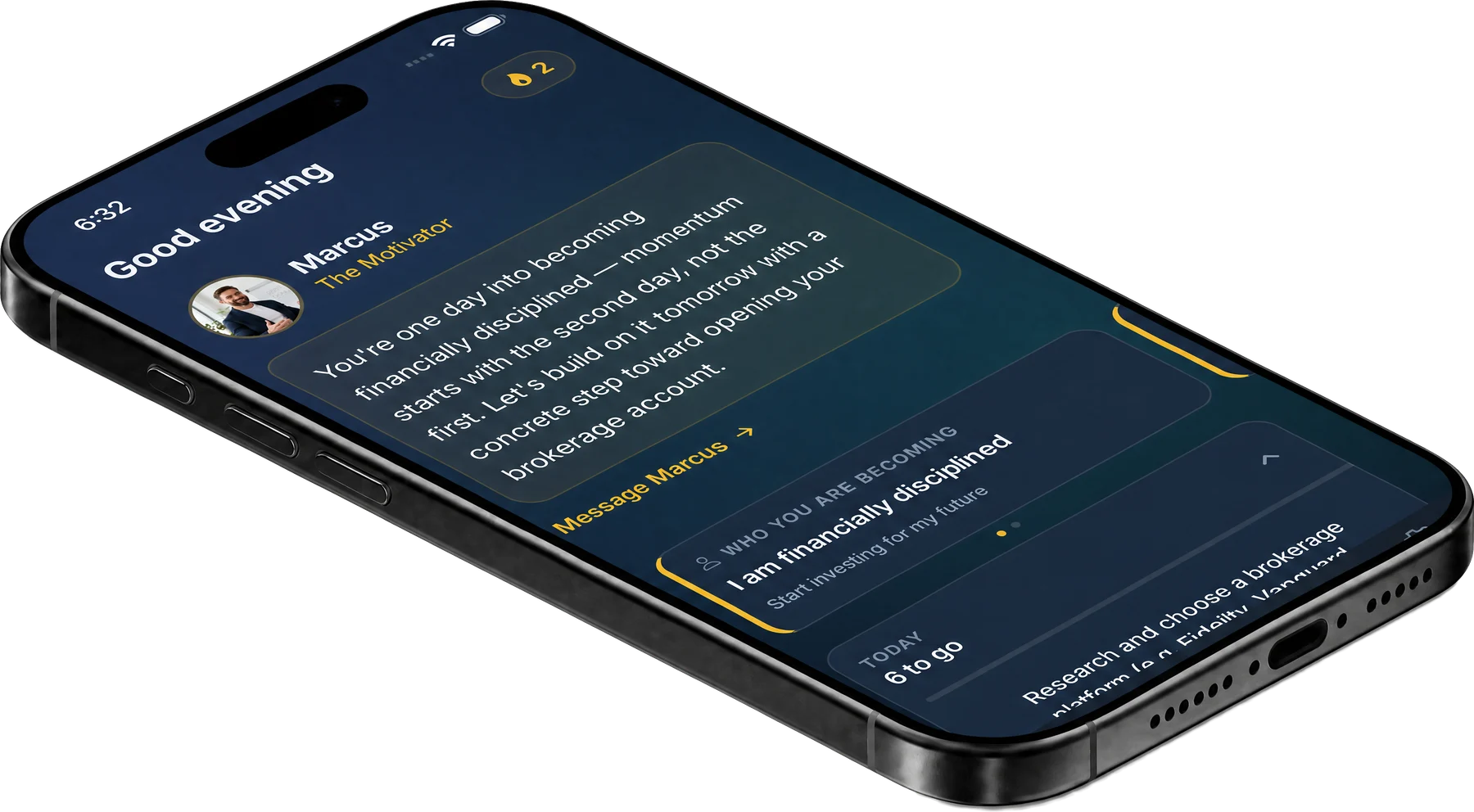
Disclosure: we build Odyssey, an AI life coach, so weigh that. What it actually does on that week is worth stating precisely, because precision is what this category is usually vague about: check-ins and plan cues arrive on a rhythm you set, with the coach's own sentence in the notification rather than a nudge to open something; the weekly review asks what went well, what got in the way, and what the coming week's focus is; and a commitment that has failed twice gets made smaller with you rather than repeated at you. That last mechanic is the one most likely to matter in the week described above, and it is the mechanism a good restart uses too.
The general point survives whatever you choose: ask what arrives, on what schedule, and whether it says anything specific.
How to pick one without collecting four
Match the kind to the shape of the failure, and give it four weeks.
The mistake is choosing by category label. Choose by the point at which things actually break down for you:
- If the failure is starting, meaning the work is fine once begun, take a body-doubling room or anything that puts a booked session in the calendar. The mechanics of starting matter more here than accountability does.
- If the failure is a spread-out goal losing its slot, take something that carries the plan and comes back on a schedule between sessions.
- If the failure is a clean binary you keep skipping, a stake app is unusually well matched, and it is the only kind that supplies real consequence.
- If you have a candidate human, stop reading and ask them for the one-way favor first, because a person outperforms all of this.
- Whatever you choose, run it for four weeks against a written definition of what changed. One tool, one goal, one sentence written before you start, which is the same method the app roundup arrives at from the other direction.
Picking an accountability app, in five lines
- Being asked, specifically, without opening anything, is the whole property
- Five kinds: matching, body-doubling, stakes, shared trackers, coaching
- A shared grid is visibility, and visibility is not a social cost
- Judge every candidate on what it does the week you go quiet
- A real person beats all of it; the one-way favor is the first thing to try
Common questions
What is the best accountability partner app?
Best depends on where your week actually breaks. Body-doubling rooms are strongest if the problem is starting, stake apps if the commitment is a clean yes or no you keep skipping, and coaching apps if a longer goal keeps losing its slot between sessions. The wider roundup sorts the shelf by job, and the honest first move is still asking a person.
Do accountability apps actually work?
They work to the extent they supply a specific question you cannot ignore, and most of the category supplies a record instead. Judge a candidate by what arrives without you opening it and whether ignoring it costs anything. For the coaching kind there are independent randomised trials, and we wrote them up with the null results included.
Can an app replace a human accountability partner?
Not entirely, and it is worth being direct about that. An app can reproduce the arriving-on-schedule half convincingly. It cannot reproduce a person whose regard you care about, which is the engine behind the whole arrangement. The comparison against a human coach goes through what each side is genuinely better at.
What about just using a group chat with friends?
It works when someone in the group takes the asking seriously, and it fails the same way shared trackers do when everyone is politely not mentioning anything. If you try it, give one person the explicit job of asking one person the same question every week. Vague mutual encouragement is the thing that reliably produces nothing.
How long should I try one before giving up on it?
Four weeks, against something you wrote down beforehand about what should be different. That is long enough to cover a bad week, which is the only week that tests the tool, and short enough that a wrong choice costs you a month rather than a year. Delete what changed nothing.
The takeaway
The category is worth using and it is worth being unsentimental about. Most of these apps supply a record and let you infer the accountability, and the few that help are the ones that produce a specific question on a schedule that is harder to cancel quietly than an intention is. Pick by where your own week breaks, run one for a month, and keep the arrangement that survives a bad Tuesday.
One thing to do today. Write the question you would want asked, in the words you would want it asked in, and name the day it should arrive. Ten minutes, and it becomes the spec you judge every candidate against, including the human one.