Somewhere between the meditation timer, the habit grid and the journal with the beautiful onboarding, the phrase "self growth app" stops meaning anything. The store category is enormous, every product in it is polished, and none of them answers the question you actually typed, which was closer to: which of these would change anything for me?
Here is the honest place to start. Self growth is a direction, and an app has a job. A direction cannot be downloaded. What can be downloaded is a tool matched to the specific thing you mean by growth this year, and the whole game is naming that thing before you install anything.
What follows: the five wants hiding inside the search, the five kinds of self growth app and the one thing each is genuinely best at, the gap almost none of the shelf fills, and a one-month method for choosing that leaves your phone lighter rather than heavier.
Self growth is a direction, and an app has a job
The mismatch between those two is why the folder of good apps changes nothing.
"Grow" is not something you can do on Tuesday at seven. It has no first step, no finish line, and no failure state, which is exactly what makes it so comfortable to want and so hard to start. An app, meanwhile, is a machine for one job: time a sit, tick a habit, hold an entry, drill a lesson. Good apps are narrow on purpose.
So when a vague want meets a narrow tool, the usual result is a folder called Growth with nine apps in it, each opened eleven times. The folder is not evidence that the apps are bad or that you are undisciplined. It is what happens when the naming step gets skipped, and the naming step is the actual work.
What people actually mean when they type "self growth app"
Five different wants share the search box, and they point at five different shelves.
Sit with the phrase for a minute and it usually resolves into one of these:
- Calmer days. Less reactive mornings, better sleep, a mind that settles on request. This want points at meditation and sleep apps.
- Promises to yourself, kept. The gym you keep meaning to attend, the reading habit, the early night. This is the habit shelf.
- A clearer read on yourself. Knowing what you actually think, noticing your own patterns before the third repeat. This is journaling.
- A skill, finally learned. The language, the instrument, the subject you have circled for years. Learning apps.
- A stalled goal, finally moving. The one you could name in under a minute, unchanged since your twenties. This is the coaching shelf, and it is the want this site knows best.
One of those probably rang louder than the others just now. That louder one is the answer to which self growth app you should get, and everything below is in service of it.
The five kinds of self growth app, and what each is best at
Neighbors in the store, barely related in what they do.
The category tour, kept short because the full roundup, with picks per job, is its own piece:
- Meditation and sleep apps are teachers. The good ones, Headspace and Calm being the long-standing pair, build a practice through structured courses, and the practice is the product. What they change is the texture of a day rather than its contents.
- Habit trackers are mirrors. Streaks and Habitica turn intentions into a visible record, which matters because a record confronts you where a vague intention lets you off. What they cannot supply is the reason the habit matters, and a tracker without a reason decays into admin. A close neighbor, goal-setting apps, solve a related but different problem: a target with an end state rather than a recurring action repeated on a schedule.
- Journals are archives. Day One holds a decade of entries beautifully. The limit is structural, and it is the honest headline of the journaling comparison: a journal records, and nothing reads it back.
- Learning apps are curricula. Duolingo and its cousins carve a skill into daily pieces, and for the narrow want of learning the thing, they are the most complete products on this list.
- Coaching apps are the odd kind out, because their subject is not a practice, a habit, a page or a skill. It is a goal: naming it, planning it, and being followed up with until it moves. The label covers more than one product, too, including some built for coaches rather than for you. That difference is the next section, because it is the one the shelf talks about least.
The gap none of the shelf fills by default
Almost every self growth app does nothing at all between opens, and between opens is where growth is decided.
Here is the quiet fact about the folder: nearly everything in it is inert until you launch it. The meditation app does not care that you stopped sitting in March. The tracker records the broken streak without comment. The journal holds whatever you bring it and asks for nothing. These are tools, tools wait, and waiting is correct behavior for a tool.
The problem is that the moments that decide growth are precisely the ones where you do not open the app: the third tired Tuesday, the week the novelty dies, the middle where projects quietly end. A shelf of waiting tools leaves every one of those moments entirely to you, which is the arrangement that produced the folder in the first place.
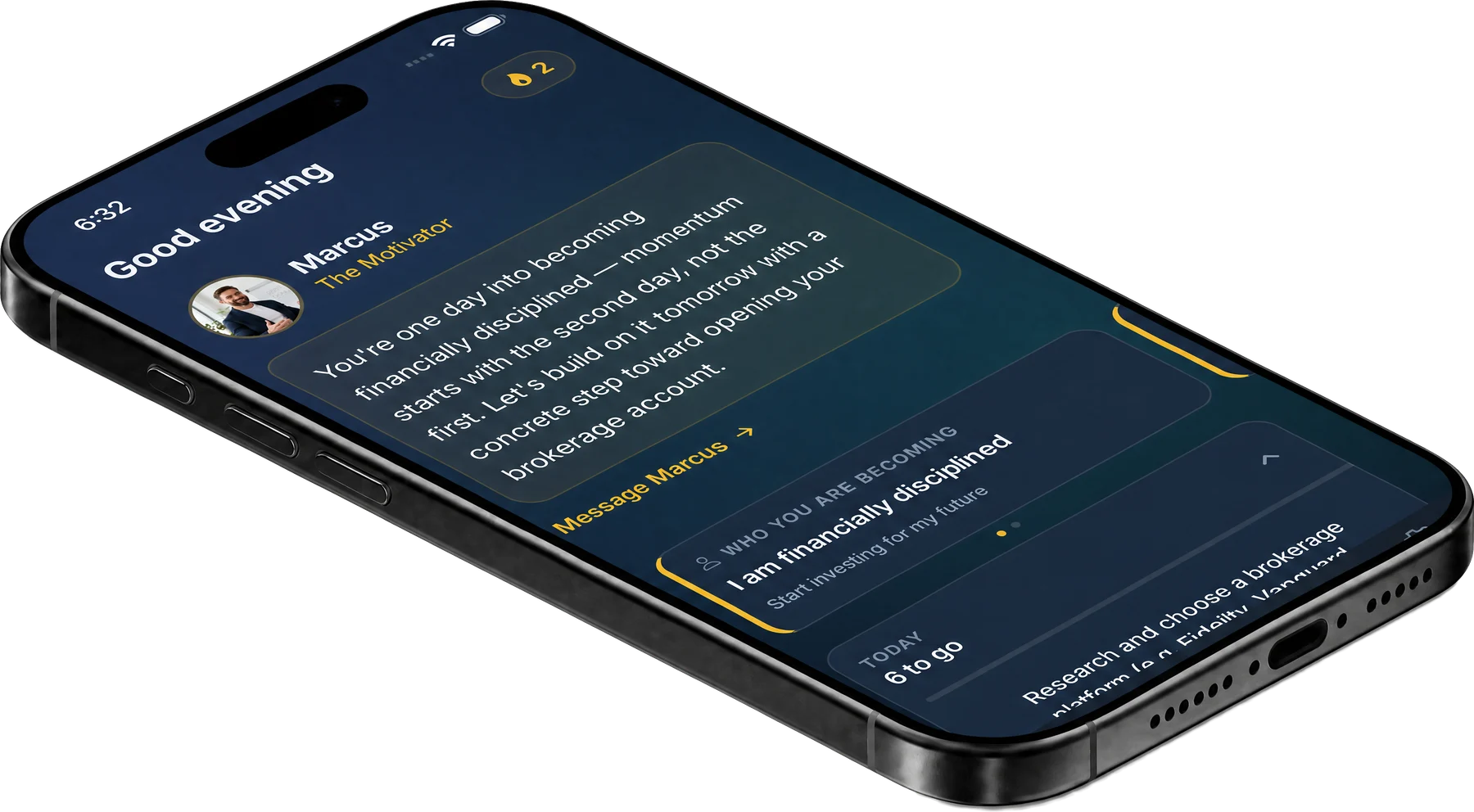
Coaching is the kind built the other way around, and, disclosure, it is the kind we build, so weigh what follows. In Odyssey you choose a coach, name the goal, build the plan with them, and the app then initiates: check-ins and plan cues arrive on the rhythm you set, and a weekly review reads your week back to you. The coaching runs on the frameworks professional coaches actually use, and the follow-through exists so that the tired Tuesday gets a prompt instead of a silence. What an AI life coach is, stated plainly, including what the category cannot do, is written up separately.
The honest caveat cuts both ways: if your want was calmer days or a learned skill, a coaching app is the wrong buy, exactly as a meditation timer is the wrong buy for a stalled goal. The gap argument matters only when the want is movement on something that has not moved.
Run a one-month experiment instead of collecting apps
One want, one app, one written line about what changed should look like.
The folder approach fails slowly and politely, so replace it with something that can actually fail fast:
- Write the want as one sentence. Not "grow", but "I want the gym to be a fact of my week", or "I want to stop discovering my own patterns two years late". If the sentence is hard to write, that is the work surfacing, and worth the ten minutes it takes.
- Install exactly one app for it. The matching kind from the tour above, the roundup has the specific picks. One, because a second app for the same want is a hedge, and hedges are how folders form.
- Define changed, in writing, before you start. What should be true in four weeks that is not true now? Sat ten times. Three entries a week. The first milestone of the stalled goal done. Concrete enough that a stranger could check it.
- Give the practice a slot, not an intention. The app prompts, but the calendar is what actually holds a practice, and a slot survives busy weeks the way "more often" does not.
- Read the month back at the end. Ten minutes, the three review questions, and one decision: the sentence changed, so the app stays, or it did not, so the app goes. Deleting an app that changed nothing is not failure. It is the experiment working.
A year run this way tests twelve apps at most and probably settles on two or three, which is what a working system looks like: the roundup's one-app-per-job rule, arrived at from the other direction.
What a self growth app cannot do, whatever kind you pick
Three limits worth knowing before you spend a month on one.
- It cannot supply the want. Every app on the shelf, ours included, assumes you arrive with something you are trying to become or do. An app can sharpen a want, schedule it and defend it. It cannot generate one, and a month with the wrong want fails no matter how good the tool is.
- It cannot make the practice free. The sits, the entries, the sessions and the milestones all still cost the time they cost. What a good app removes is the deciding, not the doing.
- It is not the right tool for every season. Coaching, and this whole category, is for people building toward something, not a substitute for other kinds of support when a season is genuinely heavy. Knowing which kind of help a stretch of life calls for is itself a piece of self knowledge worth having.
The category, in five lines
- Self growth is a direction. Apps have jobs. Name the want before the app
- Five wants hide in the search: calm, consistency, clarity, a skill, a goal
- Five kinds serve them: meditation, trackers, journals, learning, coaching
- Only coaching acts between opens, and it only fits the stalled-goal want
- Choose by one-month experiment: one want, one app, one written definition of changed
Common questions
What is a self growth app?
Any app whose job is helping you become or do something rather than helping you complete tasks: meditation and sleep apps, habit trackers, journals, learning apps and coaching apps. The label covers five barely-related kinds of software, which is why picking by the label produces a folder and picking by the want produces a tool you still use in March.
Which self growth app is best?
Best at what is the only answerable version. Headspace and Calm lead meditation, Streaks and Habitica lead habits, Day One leads journaling, Duolingo leads language, and Odyssey is our entry in coaching, which is the kind that initiates rather than waits. The full roundup with the reasoning sorts the shelf by job, and the honest answer starts with which job is yours.
Are self growth apps worth paying for?
Run the free tier until its limit actually bites, then pay for exactly the thing that bit. Meditation and learning apps earn subscriptions when the practice is real. Trackers rarely need to cost much. Whether coaching is worth paying for turns on whether follow-through is the piece you are missing, and that question has a fuller answer of its own.
Can an app really help with self growth?
An app changes outcomes when it changes behavior between opens, which is why the honest answer differs by kind. A tracker helps if you look at it, a journal helps if you write in it, and both of those are on you. For the coaching kind there are independent randomised trials, and we wrote them up honestly, nulls included, because that category makes claims that can be checked.
What is the best free self growth app setup?
Duolingo for a skill, Habitica for habits, a plain notes app for a weekly review, and a library card in Libby for the reading underneath most goals. The free coaching routes are written up separately, including exactly what the free versions do well and the two things none of them do.
The takeaway
The search was never really for an app. It was for movement, and movement starts with naming which kind you mean: calm, consistency, clarity, a skill, or a goal that has waited long enough. Name it, match one tool to it, and give the pair four honest weeks.
One thing to do today. Write the want as one sentence, the "changed" definition as another, and only then open the store. Two sentences before any download is the entire difference between a tool and a folder.