Search "AI accountability coach" and open the first few results, and they turn out to be answering different questions. One is a set of morning and evening reflection prompts. One is a chat window that promises to keep you from quitting on yourself. One is a Reddit post from someone describing the bot they built for their own use. All three carry the same three words, and only one of the underlying mechanics is actually about accountability in the sense that matters.
Here is what the term usually turns out to mean once it gets broken apart, the one property that decides whether any of it does anything, and what a real, currently operating competitor says about itself when asked directly.
Most of what carries this label is reflection, not outreach
A question set you open yourself is journaling with a prompt generator attached. Accountability is a different mechanism.
The category splits along a line that is easy to miss because both sides use the same vocabulary. One side is structured self-reflection: a daily set of questions, generated or curated, that you sit down and answer. Morning intentions, evening reviews, a prompt library dressed up as coaching. This is a real and sometimes useful product. It is not accountability, because nothing about it happens without you first deciding to open it.
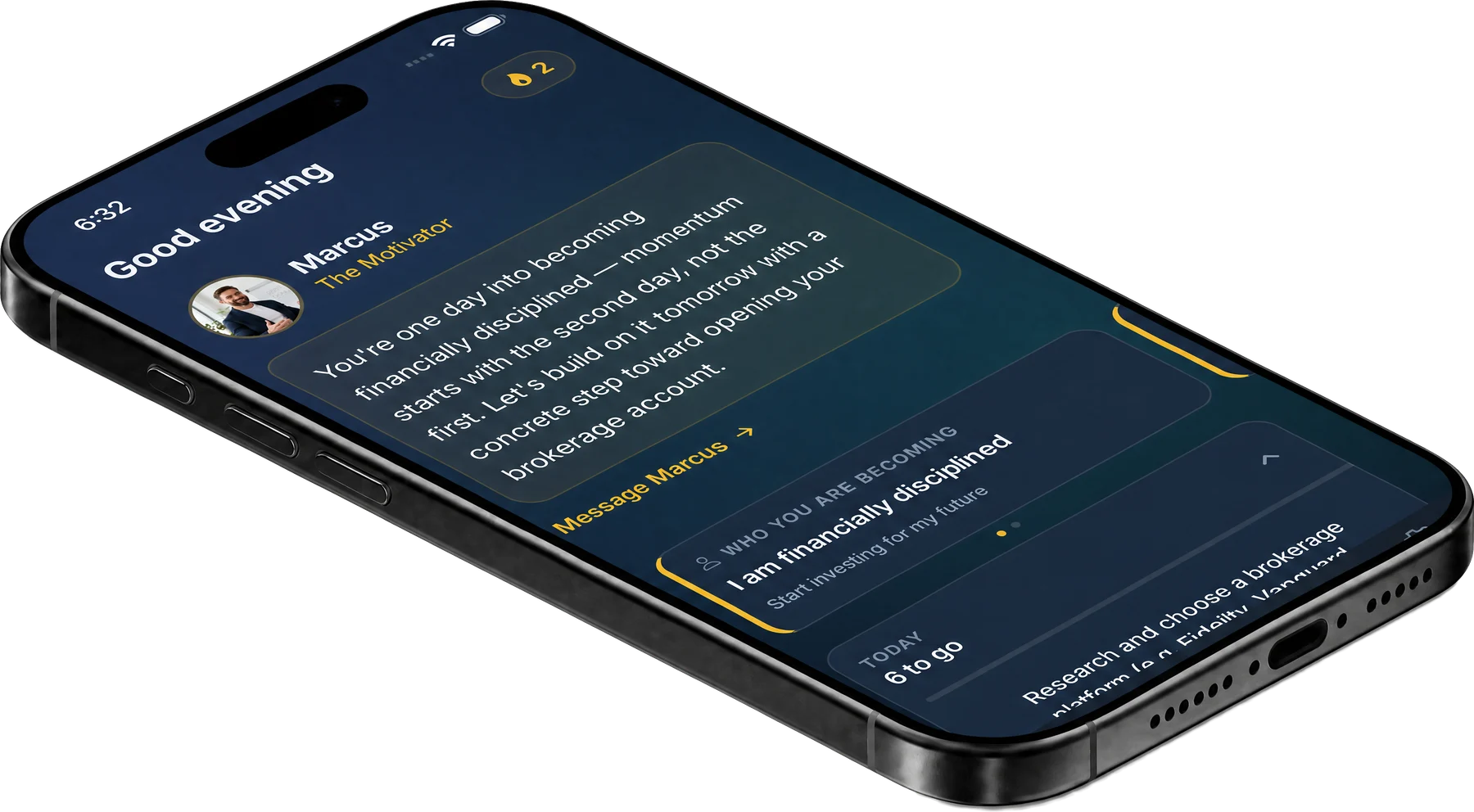
The other side is outreach: something that arrives on its own, names the specific thing you said you would do, and asks whether it happened. That is the mechanism an accountability partner actually supplies, and it is the harder thing to build, which is most of why the reflection-only version is so much more common on the shelf.
The property that decides whether any of it works
Does the product initiate, or does it wait for you to open it. Everything else is downstream of that one fact.
The single question that sorts the wider AI-coaching category applies here with extra force, because accountability specifically is the job that fails hardest when a product only responds. A beautifully designed question set that requires you to remember it exists supplies exactly the same value as a paper journal on a shelf: real, and entirely dependent on a habit that was supposed to be the thing getting built.
This is checkable before you install anything. Read the product's own description of what happens between your visits. If the answer is some version of "when you open the app," you have found a reflection tool. If the answer names something that arrives on a schedule you set, you have found the other kind.
Specific, timed and unavoidable, the same three properties a person needs
Software can reliably supply exactly one of the three properties a good accountability arrangement needs. Which one, and whether a given product actually supplies it, is the whole evaluation.
A working arrangement needs to be specific, timed and unavoidable: a named commitment, asked about on a set day, in a way that turns up whether or not you decide to engage with it. Most AI accountability products get specific and timed right without much effort, because both are just fields in a form. The third property, unavoidable, is the one that separates a real outreach product from a reflection tool wearing the label: does the question arrive on its own, or does finding it require you to already be doing the thing you needed help doing.
Worth knowing: unavoidable does not mean impossible to ignore. It means the message turns up regardless of your mood that day, the same way a scheduled push notification differs from a journal entry you have to remember to write.
A verified competitor states the limit outright
Checked against Rocky.ai's own consumer accountability page today (2026-09-27): the product describes itself as reflection, not outreach, in its own words.
Rocky.ai is a real, currently operating product in this space, and its own accountability page is a clean illustration of the reflection side of the split. It offers daily micro-coaching through structured question prompts, morning intention-setting and evening reflection, framed as being "held accountable to positive change." Read closely, the mechanism it describes is structured daily engagement that the user initiates, not automated reminders or push notifications reaching out on their own. That is an honest description rather than a gotcha: the product says plainly what it is, and what it is happens to be the reflection side of the line drawn above.
Rocky also sells a separate, unrelated product to coaches and organizations, a white-label platform for building branded coaching apps, which is worth knowing if the search brought you here for a personal tool rather than software to run a coaching business.
What no software supplies, even the outreach kind
A person whose regard you care about is not reproducible in a product, and the honest version of this category says so rather than implying otherwise.
Even a product that gets the unavoidable property right, arriving on a schedule with the specific commitment named, is not doing what a trainer you have paid or a friend you would be embarrassed to disappoint does. We build Odyssey, an AI coaching app, so weigh that: what it adds over a reflection tool is the outreach itself, a check-in that arrives on the rhythm you set rather than waiting to be opened. What it does not add is the social weight of a person, which the direct comparison between the two categories is honest about rather than papering over.
The practical order, if a person is genuinely available, is to get the person first and treat software as the fallback rather than the first choice. The five kinds of accountability app compared on this exact property is the next read once no person is available.
AI accountability coaches, in five lines
- Reflection you open yourself and outreach that arrives on its own are different products wearing the same label
- The one question that sorts them: does it initiate, or does it wait
- Specific, timed and unavoidable are the three properties a real arrangement needs
- Software reliably supplies unavoidable and nothing else automatically
- No product reproduces the social weight of a person whose regard you care about
Common questions
Is a daily question set from an app the same as accountability?
Not on its own. It is useful self-reflection, and the two are easy to confuse because both get marketed with the same three words. The test is whether the questions arrive without you opening anything on a day you would rather skip them. If they only exist once you have already opened the app, the accountability is still coming from you.
What should I check before trying one of these?
Read the product's own description of what happens between visits, in its own words, the way Rocky's page states its mechanism directly. "Structured daily reflection" and "reaches out on a schedule you set" are different products, and the honest ones say which they are without requiring you to infer it from a feature list.
Can an AI actually replace a human accountability partner?
Not entirely, and the honest products in the category say so. Software can approximate the specific and timed properties well and the unavoidable property adequately. What it cannot reproduce is the discomfort of disappointing someone you have chosen to care about being seen by, which research comparing the two directly finds rather than assumes.
Why do so many of these products look the same in the store?
Because specific and timed are easy to build and unavoidable is not. Building something that genuinely reaches out on a schedule, tracks a real commitment, and follows up on the specific thing takes more than a prompt library, so the market fills up with the cheaper version first.
Is it worth paying for one of these instead of finding a person?
Depends almost entirely on the third property rather than on price or polish. If a real person is genuinely available, a one-way favor costs less and works better. If one is not, the honest next question is whether the specific product actually initiates, because that is the only thing separating it from a journal you forgot to open.
The takeaway
"AI accountability coach" describes two different products, and only one of them does what the phrase implies. A daily question set you open yourself is reflection, useful on its own terms and not accountability. A product that names your specific commitment and asks about it on a schedule you did not have to remember is the other kind, and even the honest version of it stops short of replacing a person whose opinion of you matters.
One thing to do today. Before installing anything with this label, find its own description of what happens on the days you do not open the app. If the answer is nothing, you have found a reflection tool, useful for a different job than the one you are hiring it for.