Every December, a lot of people sit down with a stack of magazines, a glue stick and a large piece of card, and make a picture of the year they want. A beach. A finished book cover. Someone running along a coast at dawn. A tidy kitchen. It is a pleasant evening, and the board usually goes up somewhere it can be seen.
By March, many of those boards are still on the wall and most of the goals on them have not moved. That gap is why people ask whether vision boards work, and why the answers online split so sharply between enthusiasts who say they changed everything and skeptics who say they are a waste of a Sunday.
Both sides are describing the same object doing two different jobs. A vision board is good at the first job and poor at the second, and knowing which is which is what makes it useful.
This page covers what a vision board actually does well, where it falls short, how to make one that leads somewhere, and the three things to add underneath it so the pictures become a plan.
A vision board is good at deciding what you want
Choosing images forces choices about what matters. That clarifying step is genuinely useful, and many people skip it entirely.
Most adults carry a vague sense of wanting things to be different without ever pinning down what, specifically, they want. Making a board pushes you past that. You have to pick some images and reject others, and the picking turns out to be revealing: the pictures you linger over, the ones you keep coming back to, the ones you put up and then quietly take down.
Done well, that process does three useful things:
- It surfaces the goals you actually care about. Often a long-held goal shows up that never made it onto a written list, because writing it felt presumptuous and a picture did not.
- It shows the balance. A board covered in work images and nothing about people, or vice versa, tells you something no list does.
- It keeps the goal visible. A goal you see every morning is harder to forget than one written in a notebook you never reopen.
If you have not done this kind of thinking for a while, a board is a perfectly good way to do it, and so is a plain list. Personal goal examples grouped by area work as a prompt for either.
It is not good at getting you there
Pictures of a finished result describe the destination and nothing about the route. That is where most boards stall.
A photograph of a finished book tells you what done looks like. It does not tell you when the writing happens, how many words a week is realistic, what happens in the week your job takes every evening, or who would notice if the draft has not moved since February. Those are the questions that decide whether a goal moves, and a board has no way to ask them.
There is also a quieter problem. Imagining the finished result is pleasant, and for some people the pleasure of picturing it can start to stand in for the work. Looking at the board feels like contact with the goal, so the goal feels alive, even when nothing about the week has changed. That is not a reason to avoid boards. It is a reason not to let the board be the only thing the goal has.
The same pattern shows up with long-held goals in general. Wanting something badly can make it harder to start, because starting turns a perfect imagined version into a real, imperfect one. A board that only ever shows the perfect version can make that gap feel wider.
Worth knowing: if the board is full of goals that have appeared on every board for years, the problem is rarely imagination. How to stop being a dreamer and start doing is about the step that turns a dream into a scheduled action.
Make a board you can act on
A good vision board is small, specific and honest about which goal comes first.
A few choices make the difference between a board that decorates a wall and one that leads somewhere:
- Fewer goals. Three is plenty, one is better. A board with thirty images is a mood, and moods do not have first steps.
- Specific images. A picture of a particular race, a specific language course or a real neighborhood you want to live in works better than a generic sunset, because it points at something you could plan for.
- One clear priority. Make one image larger or put it in the center. That is the goal you start this month; the rest wait their turn.
- A place you pass daily. Somewhere you see in an ordinary moment, such as beside the kettle, rather than somewhere special you have to visit.
Add three things underneath each picture
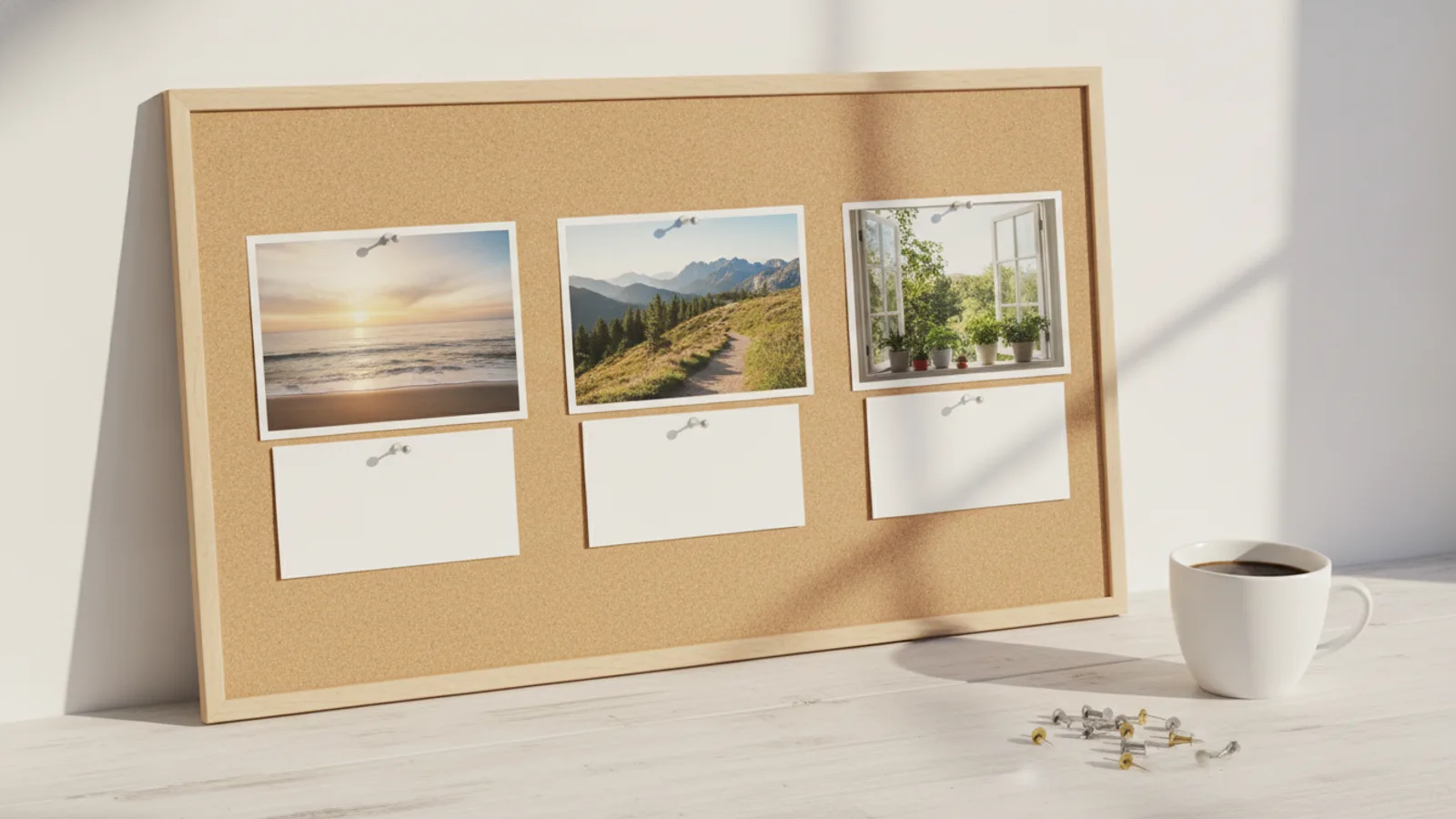
The board answers "what". Underneath it, write the three things a board cannot show: a finish line, a first step and a weekly check.
This is the part that turns a vision board from a wish list into a starting point. For each goal on the board, add a short note:
- A finish line someone else could check. "Run the coastal 10k in May" rather than the picture of the runner. "A complete first draft by the end of June" rather than the book cover. SMART goals for self-improvement shows how to rewrite a vague goal into one that can be finished.
- A first step with a date. Something small enough to do this week, written with a day and a time. Twenty minutes of the real activity, not research about it.
- A weekly check. The same day each week, ask what moved, what got in the way and what the next step is. Three weekly review questions are enough, and the board makes a natural place to do it.
From there, the goal needs what any goal needs: a short plan of four or five milestones and someone or something asking how it went. The six decisions that come before the effort lay that out in full. Disclosure: we build a coaching app, so weigh this accordingly. In Odyssey the coach helps break the goal into milestones when you set it, and check-ins and a weekly review arrive on a rhythm you choose, which covers the part of the plan a board cannot. A friend who asks every Sunday about the first step covers much of the same ground.
Vision boards and the new year
January is when most boards get made. Make the board in December and the plan in the same sitting.
Vision boards peak around the new year, which is both a good and a bad time for them. Good, because the reflection that comes at the end of a year is exactly the thinking a board helps with. Bad, because January is crowded with fresh starts that fade by February.
Two adjustments help. Make the board a little before the new year, while there is time to think rather than react. And write the three notes beneath each picture in the same sitting, so the board and the plan are born together rather than the plan being something to get around to. New year goal setting covers the rest of the process, including planning for February before January starts.
Do vision boards work, in five lines
- A vision board is good at clarifying what you want and keeping it visible
- It says nothing about the first step, the schedule or the bad weeks
- Picturing the result can feel like progress, so do not let the board be the whole plan
- Keep the board small, specific and clear about which goal comes first
- Under each picture, add a finish line, a dated first step and a weekly check
Common questions
Do vision boards actually work?
They work for clarifying what you want and keeping it in view. On their own, they do little to move a goal forward, because pictures of a finished result do not include a first step, a schedule or a way to recover from a missed week. Paired with a simple plan, a board can be a useful starting point.
How do you make a vision board that works?
Keep it small, with one to three goals and one clear priority. Use specific images that point to something you could plan for. Under each picture, write a finish line someone else could check, a first step with a date, and a weekly time to review progress. Put the board somewhere you pass every day.
What should I put on a vision board?
Choose images for the few goals you most want to move this year, and make them as specific as possible: a particular event, place or project rather than a general mood. Leave room beneath each image for a short written plan, which is the part that turns the board into something you can act on.
Is a vision board better than writing goals down?
They do different jobs. A board is often better at surfacing what you want and keeping it visible; a written plan is better at saying what to do next and when. Using both together, the picture for the why and the notes for the how, tends to work better than either alone.
When should I make a vision board?
Any time you want to rethink what you want, though many people make one around the new year. If you do, make it a little before January and write the plan for each goal in the same sitting, so the board does not end up as the only thing your goals have.
The takeaway
A vision board is a good tool for deciding what you want and a poor tool for getting it. Keep the part it does well: the choosing, the clarity and the daily reminder. Then add what it cannot show, a finish line, a first step with a date and a weekly check, so the picture on the wall has a plan under it.
One thing to do today. If you already have a board, pick the one image you most want to see happen this year. On a card beneath it, write its finish line, a twenty-minute first step with a day and time this week, and the day to check on it each week. Ten minutes, and the board has a plan.